
Training surgery as left-handed
– Or supervising a left-handed learner when you are a right-handed teacher?
Training surgery as a left-handed person comes with its own set of challenges, as supervisors are often right-handed and instruments designed for right-handed operators. Here, you’ll find material targeting left-handed operators, demonstrating surgical techniques and surgical skills training performed by a left-handed operator on models, as well as in clinical practice with patients.
In this 2-hour course, you will learn about:
Instrument handling as a left-handed learner
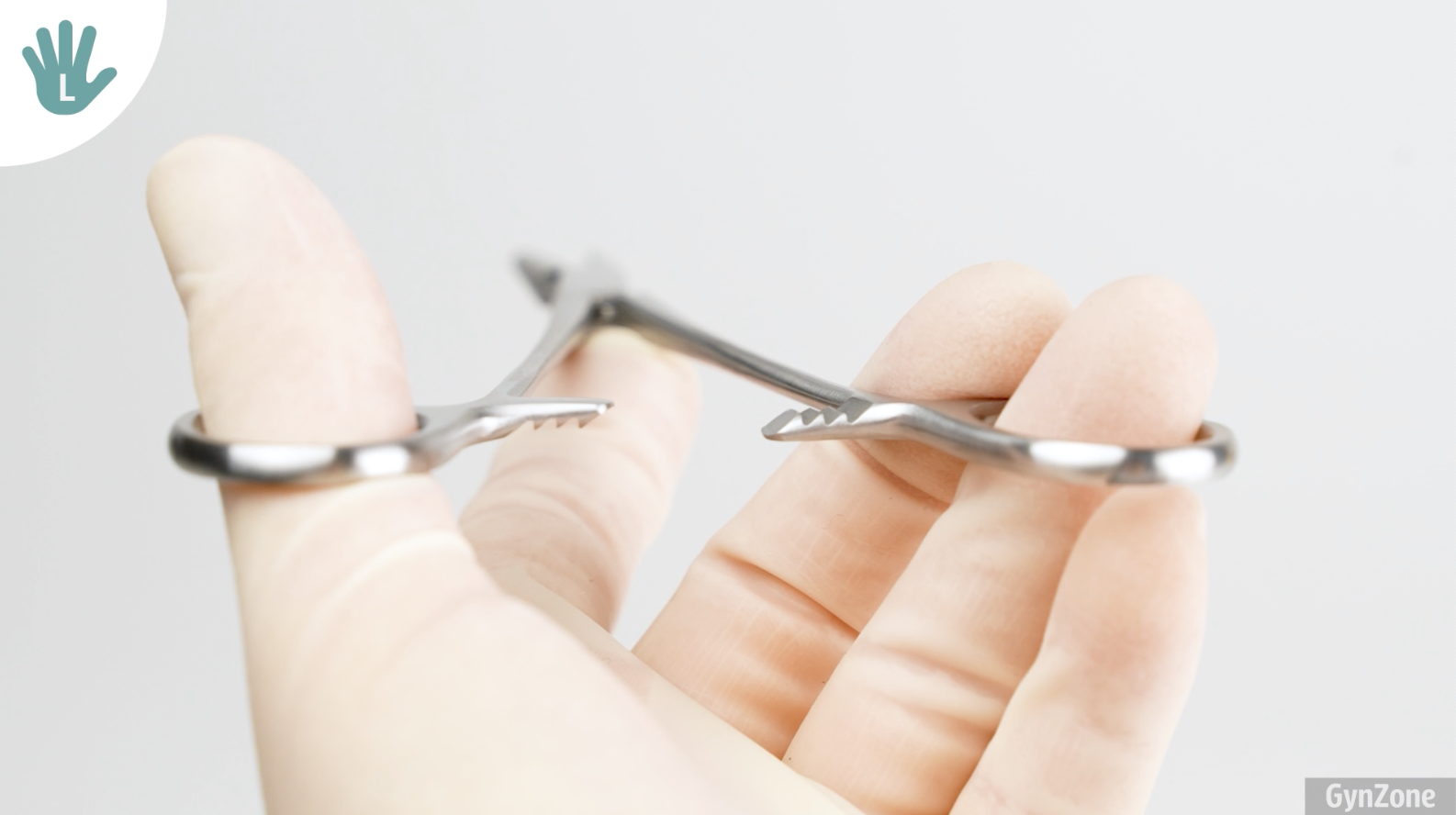
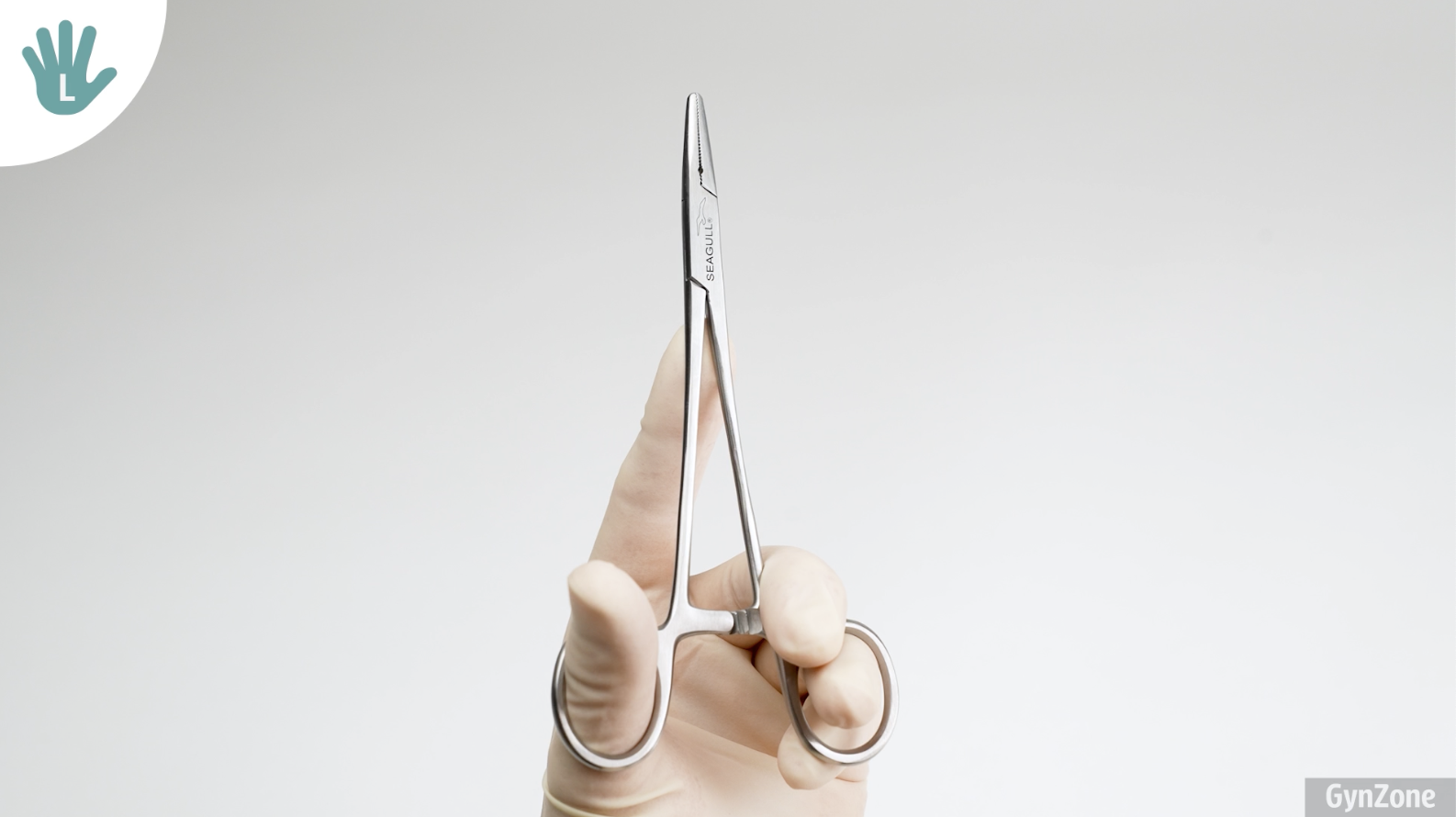
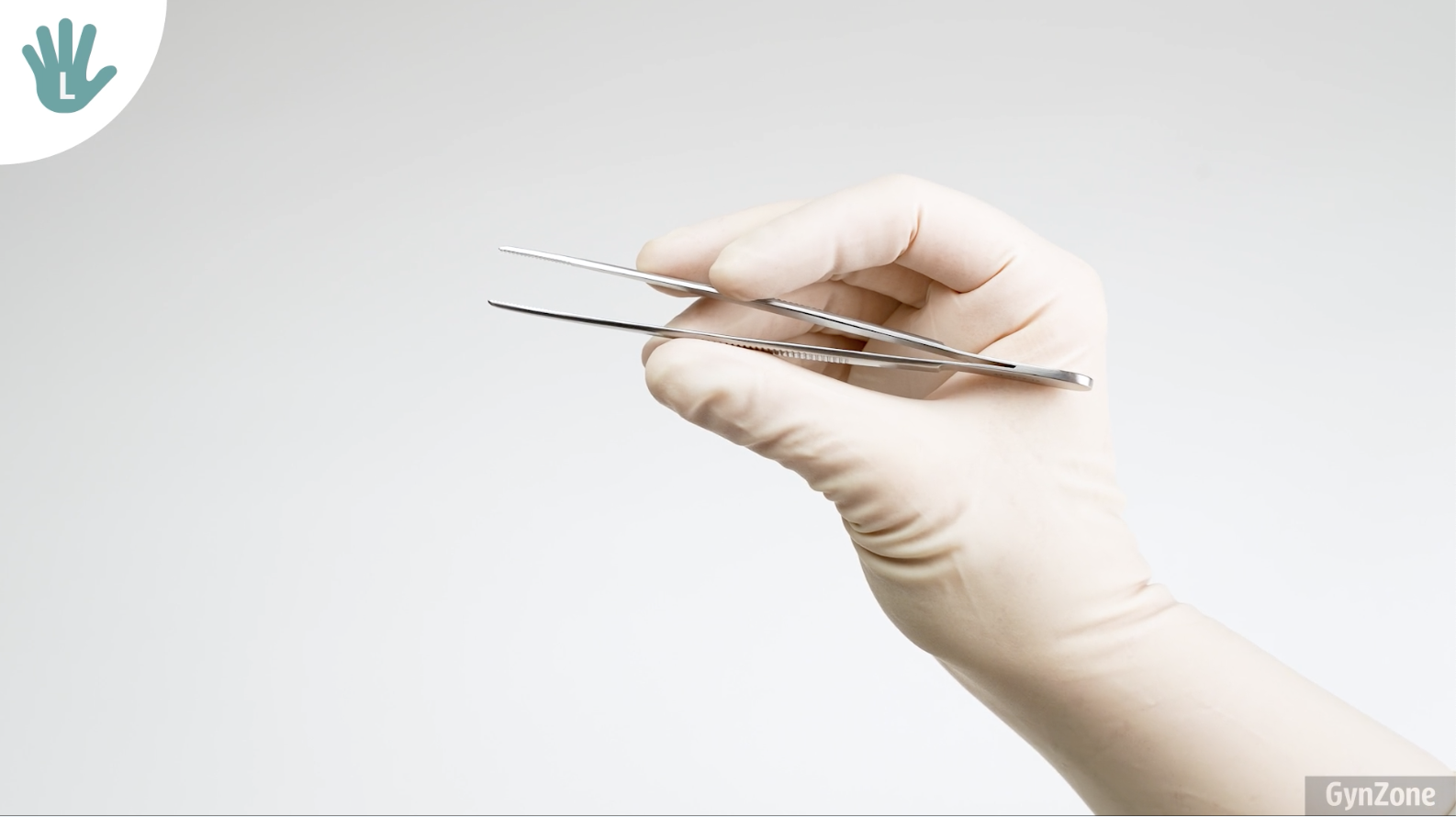
Here, the instruments that can be used for suturing are presented. Some left-handed operators use instruments specifically designed for left-handed individuals, as shown here. Others have learned to use instruments designed for right-handed individuals.
The needle holder is handled with the dominant hand. To achieve the best ergonomics, the instrument is held with a three-point fixation, which makes the movements controlled. The two eyes of the needle holder are held with the thumb and ring finger, while the index finger rests along the shaft. This allows you to guide the needle holder with the middle finger, control it with the index finger, and guide the needle in a smooth motion using the wrist.
The needle holder has a built-in locking mechanism in the shaft, so it can be locked, thereby holding the needle firmly. The grip is unlocked when the needle needs to be released. On needle holders for left-handed individuals, this locking mechanism is reversed compared to instruments for right-handed individuals.
The anatomical forceps are handled with the non-dominant hand, resting along the index and middle fingers. The forceps can be squeezed together using the thumb and index finger. The tips of the forceps are cross-hatched for better grip.
The surgical forceps are handled like the anatomical forceps but differ in that the tips have sharp teeth, which can grasp and mobilize tissue.
The scissors are held with a three-point fixation, just like the needle holder. With scissors specially designed for left-handed individuals, it is much easier to cut the thread.
Knot-tying technique
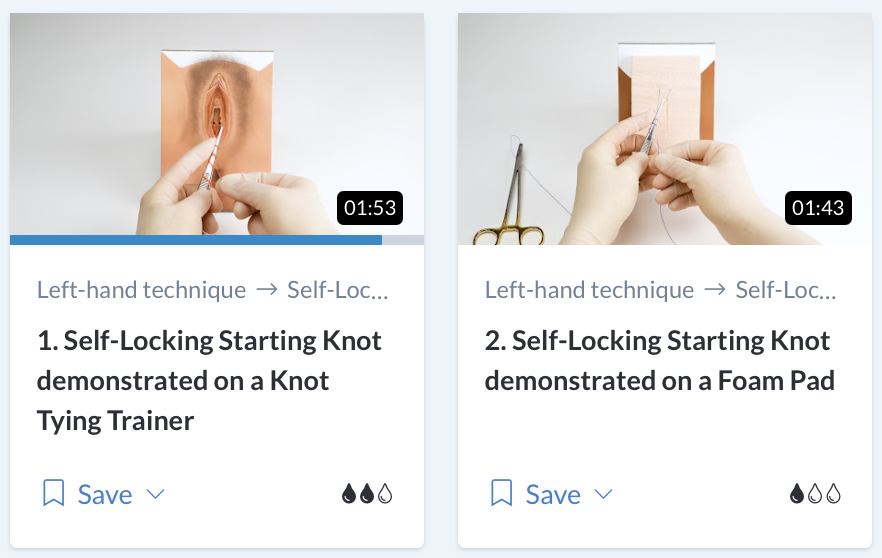
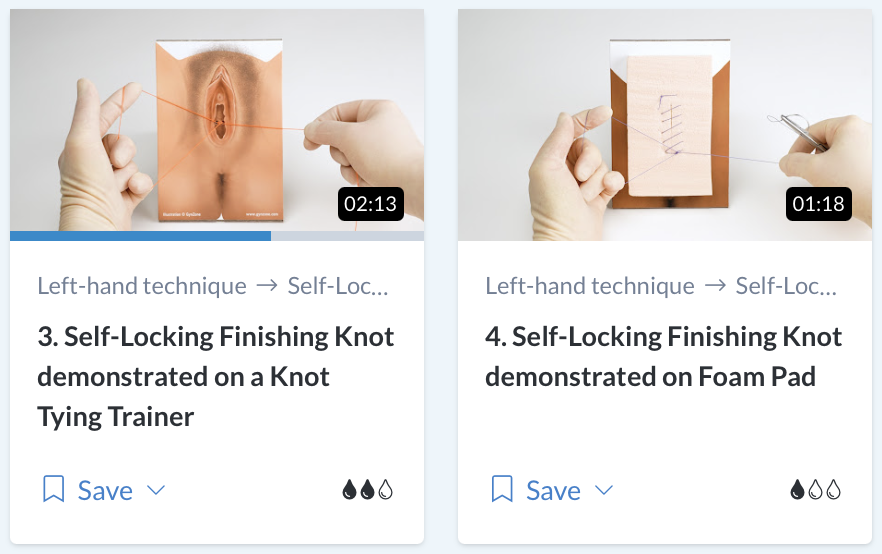
Self-locking starting knot – Demonstrated on a knot tying trainer
A self-locking starting knot is used before continuous suturing. The knot tying trainer is now being threaded, with one of the ends left short. This simulates having just placed a stitch, resulting in a short and a long thread.
For this exercise, you can use either forceps or a needle holder; forceps are used here. Hold the threads with one hand, flipping the short thread up to make it easily accessible. Hold the forceps with the other hand, ensuring the tip of the instrument always points towards the patient.
Guide the instrument under the two threads and move it around the thread in the direction towards the patient. Use your index finger to stabilize the threads so they don’t slip off the instrument. A total of three throws are made.
Next, grasp the short thread with the instrument and pull it through the loop of suture material. Pull both threads towards yourself to form the knot. The short thread is cut 0.5 to 1 cm from the knot before it is guided into the vagina, which avoids the need to cut the thread inside the vagina and reduces risk to the patient.
With a pull on the long thread, slide the knot into place. Help the knot along to avoid pulling on the tissue and to ensure the knot is tightened suitably. The knot should be followed by continuous suturing; otherwise, it will unravel. If you want to repeat the exercise, cut the thread and remove it from the model. Thread the model again so the exercise can be repeated.
Continuous and interrupted technique
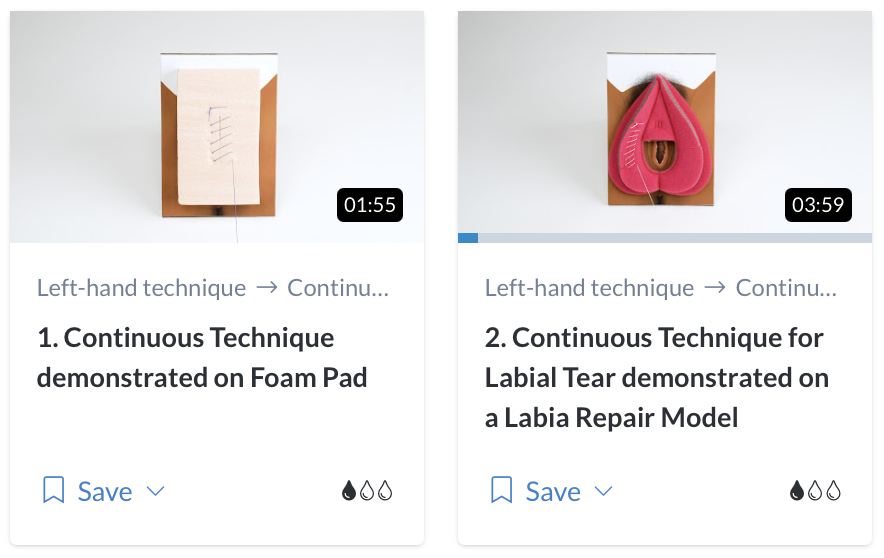
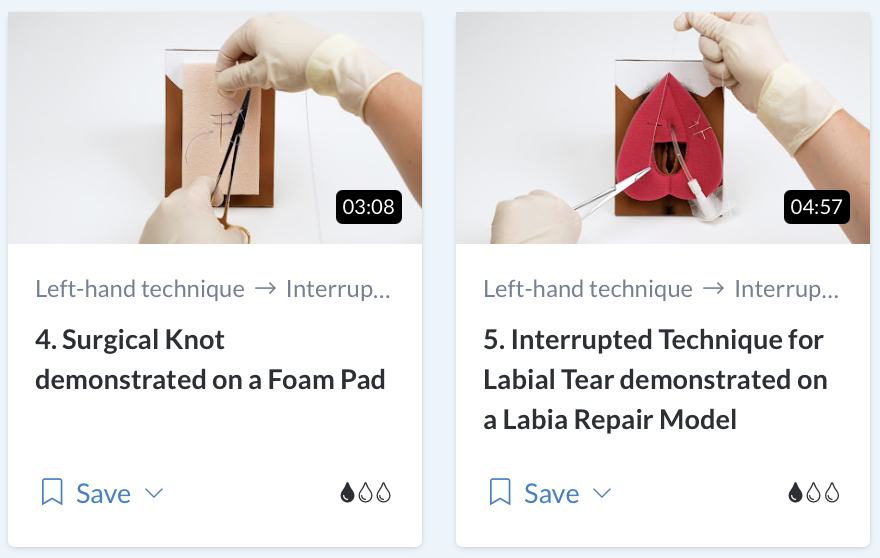
In this chapter, you’ll be guided in how to train surgical knots and square knots as a left-handed clinician, in a safe and dry environment. To start, we use a knot-tying trainer with large coloured bits of string, to make it clear when the right pattern is achieved in the knots. Then we move on to the more finicky surgical sutures and use a foam pad to simulate tissue. Finally, both the interrupted and continuous techniques are demonstrated on a labia repair model, to better simulate the right angle for an actual repair.
Clinical surgery cases with patients
Because the complexity of real-life lacerations is much higher than what can be achieved in simulation training, we show examples of actual surgeries performed by a left-handed clinician.
Case 1 is repair of a grade 1 tear and a labial tears.
Case 2 is a 2nd-degree laceration, involving the bulbospongiosus muscle and the superficial transverse perineal muscle. The tear is repaired using a continuous technique, with stabilizing Aberdeen knots between the different anatomical layers.
Case 3 is another 2nd-degree laceration, involving the bulbospongiosus muscle and the superficial transverse perineal muscle. The tear is repaired using an interrupted technique.
That’s what our members are saying

Cathrine Gjersing Nielsen
Midwife

I had to learn to suture while at the same time mirroring something that’s already quite complex. I have sorely missed having somewhere to go to, and have worked with both midwives and clinical supervisors who had difficulties “turning it around” in their heads
Midwife, Hvidovre Hospital

Even now, 6 years after qualifying, I feel ’awkward’ in my instrument handling as well as in the suturing itself, because I am trained as a right-handed but suture as a left-handed
Midwife, Hjørring and Aalborg Hospitals

I am SO happy for the lefthanded students 🙏 And for their supervisors😉
Midwife, Esbjerg Hospital
Authors of the course
Sara Kindberg
Midwife, PhD, Founder of GynZone
Clinical Perineal Care Specialist.
Sara wrote her PhD Thesis on suturing of second-degree perineal trauma in 2008.
Eva Dimon
Midwife, Clinical specialist
Eva specialises in perineal repair and postnatal evaluation of healing.
Karina Klavsen
Midwife, Clinical specialist
Karina is a left-handed midwife, who specialises in perineal repair training
Peggy Seehafer
Midwife, Anthropologist
Peggy is the author of clinical textbooks and articles, participates in national guideline reviews in Germany, and has 30 years of clinical experience.