
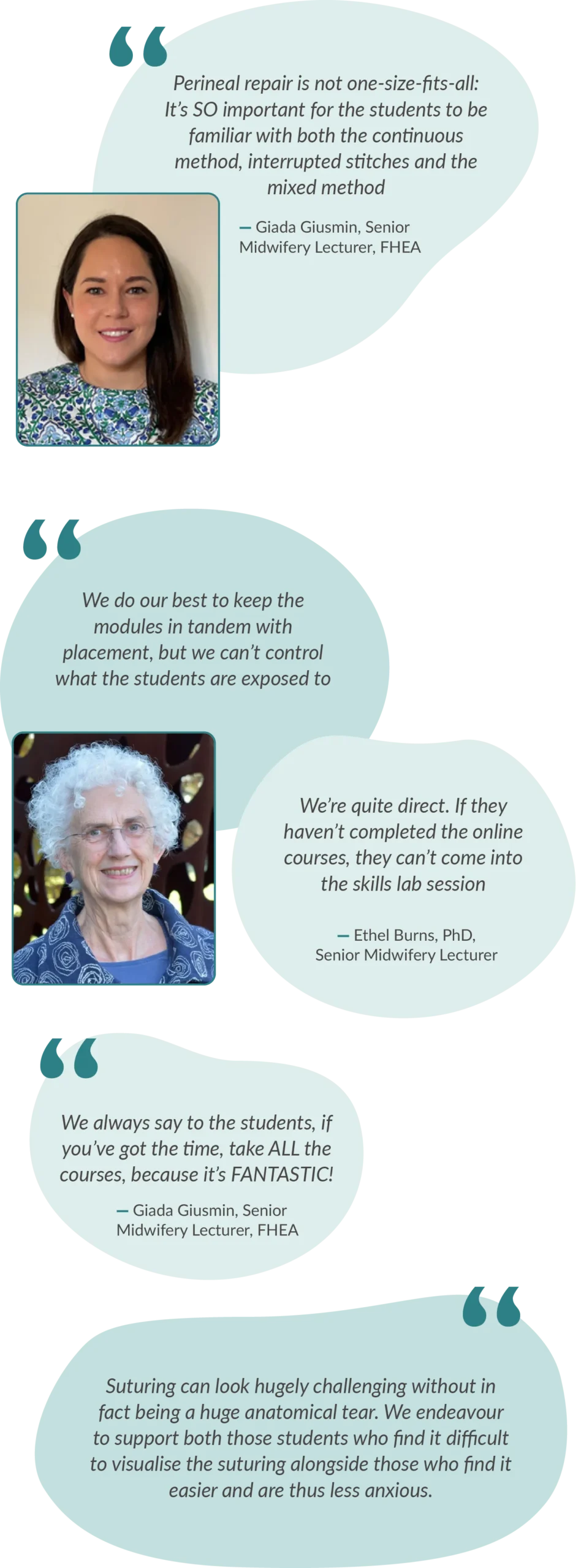
“Perineal repair is not one-size-fits-all”
Oxford School of Nursing and Midwifery


Institution: University

Location: Oxford, England

Institution size: 150 midwifery students
Background and challenges
Oxford Brookes University offers both a BSc and MSc 3-year direct entry midwifery degree, and a 2-year BSc in Midwifery for qualified nurses. The educators take great pride in working with the Nursing and Midwifery Council to integrate the curriculum closely with clinical placement to ensure maximal relevance. The team is committed to integrating theory and practice using the best available evidence through its midwifery programmes. It also seeks to align clinical placements as closely as feasible to academic learning. Students experience a range of community and hospital placements. In their final year, they also have the opportunity to caseload a small group of pregnant women adopting a continuity of care model.
Students can observe perineal repairs having learned about the anatomy and physiology in year 1, revisit in year 2 about the range of tears and repair technique introduction, and practical sessions following completion of several modules on the GynZone platform in Year 3. The university seeks to ensure that students receive consistent high-quality clinical exposure, regardless of the variations encountered in clinical practice.
Implementation
In Oxford Brookes, the student midwives use GynZone in an intensive blended learning setup shortly before qualifying. Prior to their perineal repair skills lab day, they are required to complete a selection of self-paced online courses covering safe surgical practice, knots and stitches, diagnostics of obstetric lacerations and pain relief and repair of various types of lacerations.
The students are required to submit their certificates from the online courses prior to the hands-on day in the skills lab.
The skills lab session consists of repair training with small student groups, combined with sharing reflections from their placements about perineal tears alongside their experiences and thoughts about midwifery care during the second stage of labour. The reflections generate discussion through which the facilitator threads research regarding the use of warm wet compress, style of pushing, maternal birth position, and hands-on or poised as baby’s head emerges. Discussion encompasses the importance of good postnatal care for maternal health and wellbeing.
Following the skills lab session, students are encouraged to revisit the online courses.
The impact
- Students become familiar with both the continuous technique, single stitches and mixed methods of repair. A wider range of skills make them better equipped to treat different lacerations
- Teaching for left-handed students is improved by making their own subgroup during training, and receiving tailored instruction
- Students report reduced anxiety about treating birth lacerations
- Educators report great satisfaction with the variety of clinical cases and techniques to teach from. “Perineal repair is not one-size-fits-all”
Conclusion
Students state that GynZone’s self-paced courses enable them to take their time and revisit complex cases until they feel confident in their knowledge and skills.
The thorough preparation prior to hands-on training improves their outcome from the clinical skills lab.
Lastly, students proudly report satisfaction with being able to partake in repairs during clinical placement, both in shared care settings where they perform partial repairs alongside their supervisors, and in performing complete repairs themselves.
Other GynZone stories

GynZone supports the Ukrainian Association of Midwives
GynZone supports the Ukrainian Association of Midwives with free training and licenses, helping midwife supervisors build lasting clinical expertise.
Institution: NGO
Location: Ukraine 
Global reach: 1,000 midwives and healthcare professionals

Queensland Health partners with GynZone for midwifery care
Queensland Health partners with GynZone to deliver state-of-the-art clinical training to 1,000 midwives across Queensland in a new strategic rollout.
Institution: Government/ Public Health
Location: Australia 
Global reach: 1,000 midwives and healthcare professionals

Maternity foundation
Every year, millions of women in fragile and low-resource settings experience birth injuries, often worsened by insufficient access to skilled repairs. he consequences can be lifelong: pain, infections, incontinence, and social stigma.
Institution: NGO
Location: Copenhagen, Denmark 
Global reach: 500,000 midwives and healthcare professionals

University of South-Eastern Norway
The University of South-Eastern Norway enhanced midwifery training by integrating GynZone’s e-learning and hands-on workshops. This early preparation resulted in allowing students to take an active role in clinical placements from day one.
Institution: University
Location: Horten, Norway 
Institution size: 80 midwifery students

Thomas Jefferson University
Thomas Jefferson University uses GynZone to deliver consistent, high-quality training for remote midwifery students. Furthermore, educators report benefiting from structured, up-to-date resources, ensuring effective teaching both remotely and on-campus.
Institution: University
Location: Philadelphia, USA 
Institution size: 80 midwifery students

Vaasa Central Hospital
Vaasa Central Hospital enhanced diagnostic skills and fostered a strong learning culture by implementing GynZone. Midwives, doctors, and students learn together, sparking motivation, joy, and curiosity while still improving suturing techniques.
Institution: Hospital
Location: Ostrobothnia, Finland 
Institution size: 1200 births annually

Epping Hospital
Epping Hospital used GynZone to enhance midwives’ skills in perineal repairs, boosting confidence, competence, and clinical outcomes. GynZone empowers staff with the knowledge and skills for better patient care.
Institution: Hospital
Location: Epping Victoria, Australia
Institution size: 4000 births annually

University of Technology Sydney
Midwifery students at UTS felt unprepared for birth lacerations. With GynZone, they gained confidence, improved skills, and reduced anxiety — leading to more competent students.
Institution: University
Location: Sydney, Australia 
Institution size: 320 midwifery students